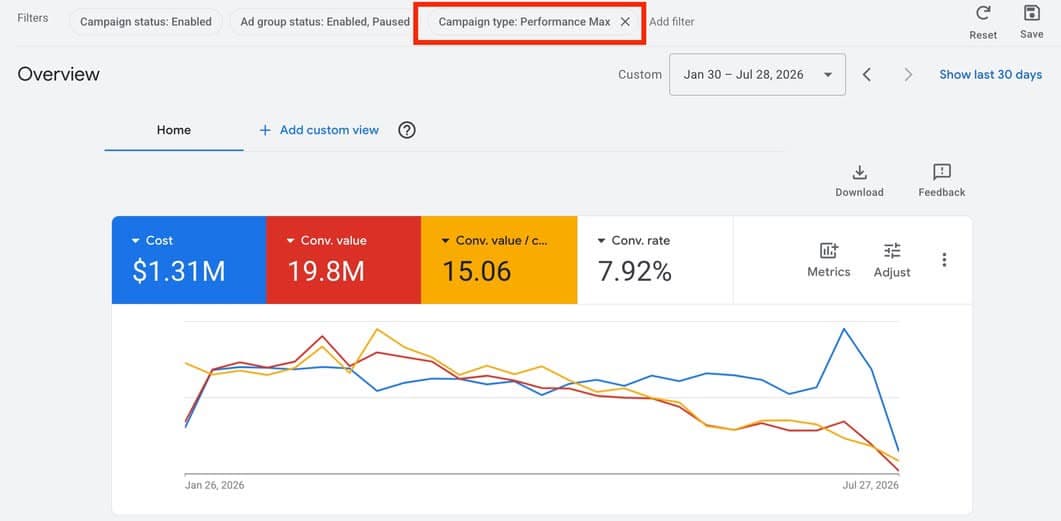
Google Ads · Performance Max
$19.8M
Google Ads conversion value
Jan 30–Jul 28, 2026 · $1.31M cost · reported conversion value/cost 15.06.
Screenshot and metric breakdown →We run store advertising against return on ad spend, not clicks. One channel starts at $650 per month, with the ad budget counted separately. First orders arrive within 7–10 days, a stable ROAS in 4–6 weeks.
Anonymized commerce projects. We show the source, period and metric type so every number can be read in context.
Jan 30–Jul 28, 2026 · $1.31M cost · reported conversion value/cost 15.06.
Screenshot and metric breakdown →
$3,904,687.83 in the CV column · 63,922 purchases. The date range is not visible.
Screenshot and metric breakdown →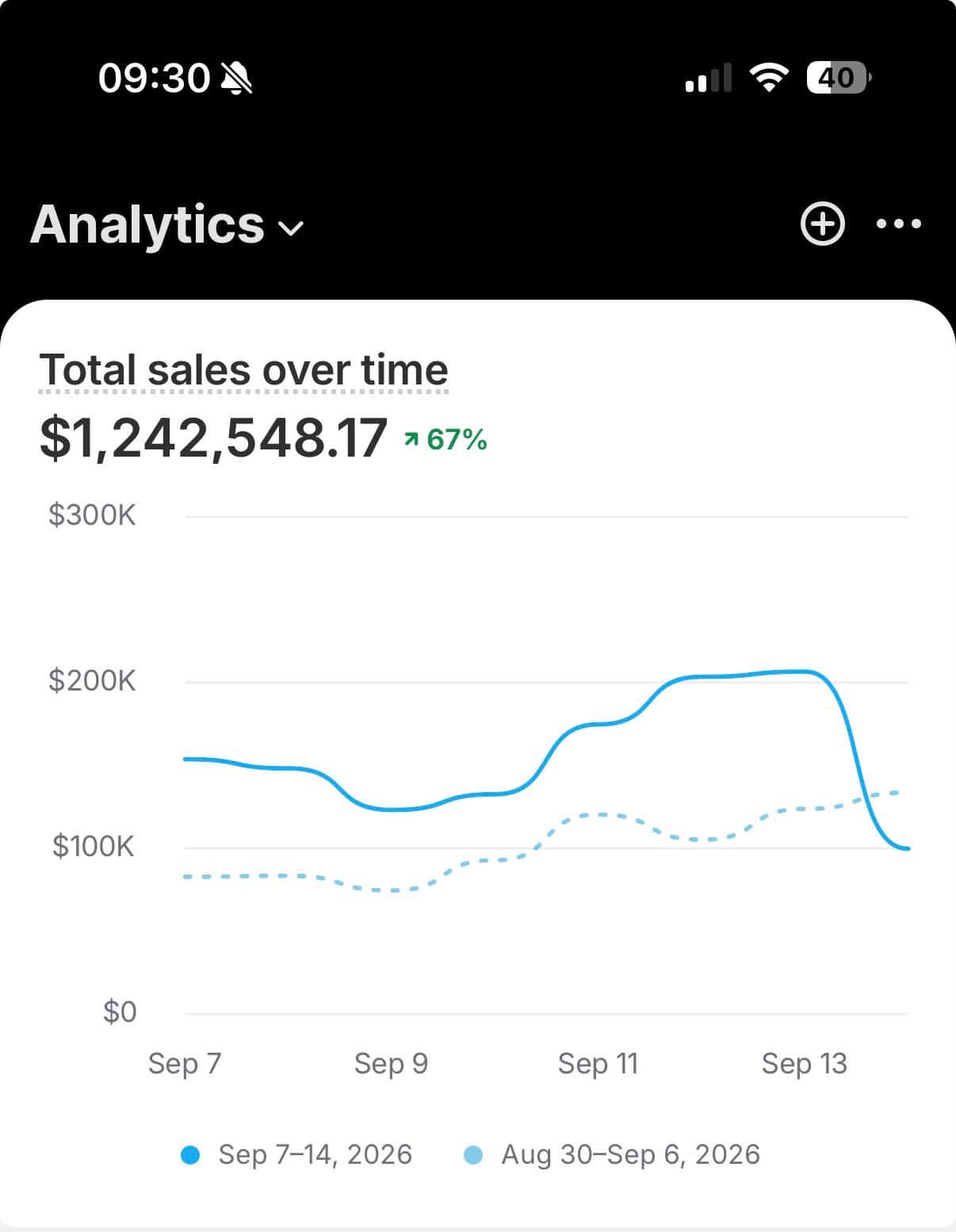
$1,242,548.10 · Sep 7–14, 2026 · +67% vs Aug 30–Sep 6.
Screenshot and metric breakdown →Metrics come from separate report extracts and must not be added together. Revenue and conversion value are platform-attributed figures, not a promise of future results.
The full set of channels starts at $1,500 per month, and a test ad budget is usually $1,000–1,500. We combine Google Shopping and Performance Max, Meta, and customer return through email and SMS into one system measured by a single number: revenue per dollar spent. In the project where we hold the account export, that produced $19.8M in revenue on $1.31M of spend between 30 January and 28 July 2026 — ROAS 15. Below: what the price is made of, what we set up, and where stores lose budget.
There are always two separate sums, and mixing them hides the truth.
If an agency quotes a single number, ask for read access to the ad account. Without it there is no way to tell the fee from the media spend.
Three causes visible in almost every account we open.
Four blocks that work as one system.
When the limit is the site and the checkout rather than traffic, that is separate work — see Shopify and online store growth.
Between 30 January and 28 July 2026 the store made $19.8M in revenue on $1.31M of ad spend — a 15 to 1 return. Account screenshots are in our cases.
Three things produced it: Performance Max on a clean feed, splitting products by margin so the algorithm stopped buying cheap traffic for low-margin items, and passing order value into the account so the campaigns optimised for revenue rather than conversion count.
Per the Meta ad account, the channel produced 63,922 purchases worth $3.9M. The mechanics are plain and repeatable: a product catalogue, dynamic retargeting on viewed items, and a separate new-customer campaign with a cap on acquisition cost.
In the Shopify admin, the week of 7–14 September 2026 shows $1.24M in sales, 67% above the previous week. A jump like that is almost never a new creative — it is demand, stock and a site ready to take the traffic lining up at once.
A repeat buyer costs less than a new one: no auction to win, no case to make from scratch. In this project email and SMS produced $1.23M — $1.13M from email and $101K from SMS.
We set up abandoned cart and abandoned browse, the first repeat after delivery, reactivation of buyers who went quiet, and segments by category and order value.
Selling through marketplaces works differently — see Amazon, eBay and Etsy.
A free 5-minute audit: growth points and where you're losing budget.
Get a free auditWe will review your market and offer, then suggest channels and a test budget. Agency fees and ad spend are separate.
By submitting you agree to the privacy policy.
The team costs from $650 per month for one channel and from $1,500 for the full set. The ad budget is separate: a Google Shopping and Meta test usually needs $1,000–1,500 per month. We give the exact figure in the estimate, after reviewing the niche and competitors.
Three to five is the usual benchmark — it covers both the product and the advertising. Anything above depends on margin and repeat purchases. In our Performance Max project ROAS was 15 between 30.01 and 28.07.2026, but that came from high margin, a clean feed and optimising for revenue, not from the channel alone.
First orders usually land within 7–10 days of launch. A stable ROAS forms over 4–6 weeks, once the algorithms have enough data about buyers.
Yes, with any platform that can produce a product feed. If the feed is missing or wrong, we build it — Google Shopping and the Meta catalogue cannot work without one.
We review the current campaigns for free and show where the budget leaks: structure, feed, negative keywords, order value tracking. What to do next is your call.
Weekly: spend, revenue and ROAS by channel and product group. No reach, no likes, no engagement.
With a free audit: we look at your niche, competitors and current metrics, then propose a plan and quote.
We guarantee transparency and KPI-based work. Concrete numbers are fixed in the plan after the audit — no promises out of thin air.
Russian, Ukrainian and English. We run projects in Ukraine, Israel and the USA.